Sell and fulfill reliably
Successful Stripe Checkout sessions create orders, order items, API keys, and active license records through idempotent processing.
- Paid-order creation
- Entitlement fulfillment
- API-key issuance
- Duplicate-event protection
ForgeFX is a production SaaS platform for selling digital software, fulfilling purchases, issuing licenses and API keys, enforcing subscription state, operating a multi-seller marketplace, and giving buyers, sellers, administrators, finance, support, and operations teams purpose-built command centers.
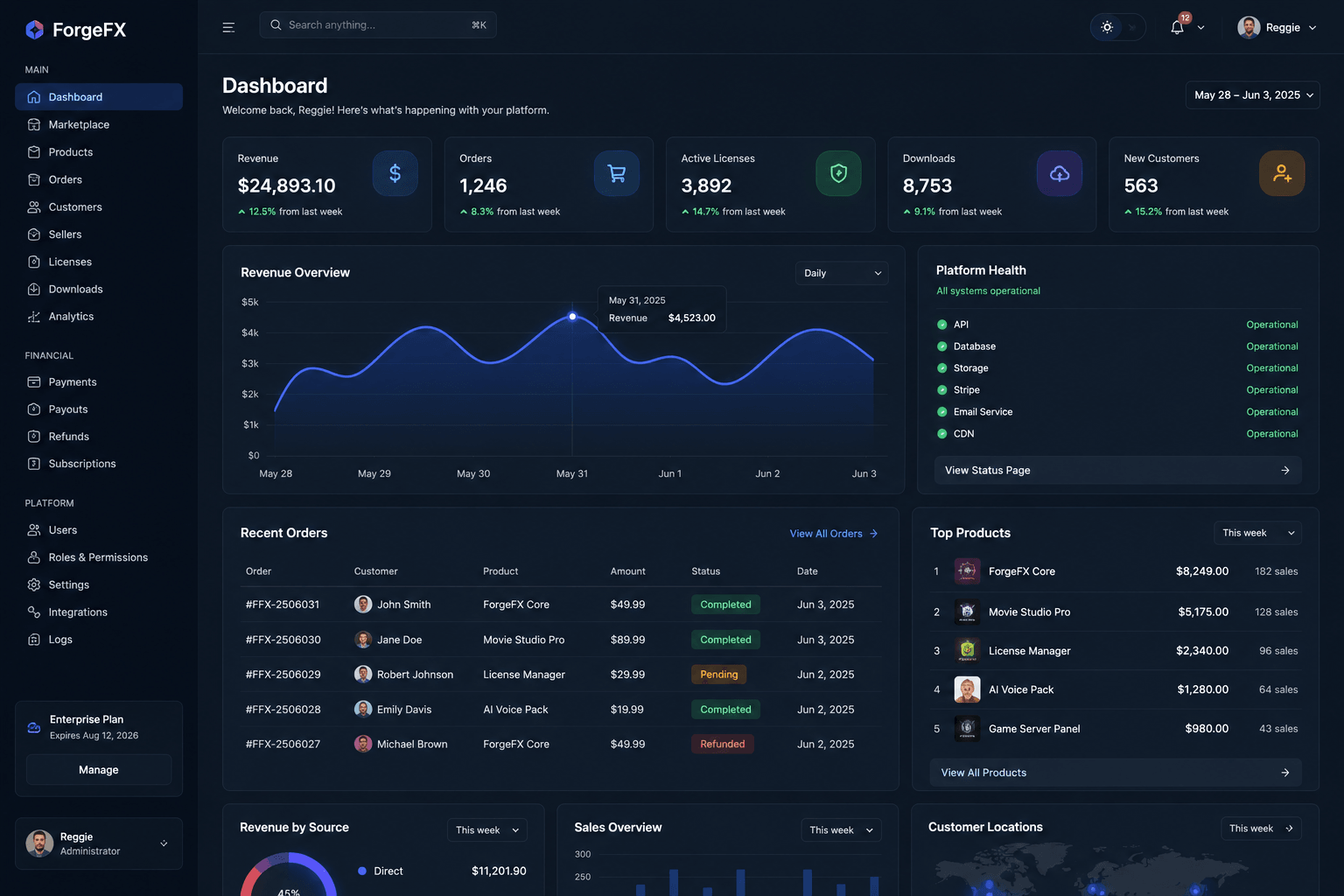
Make commercial software operations explicit. Checkout, ownership, downloads, licensing, subscriptions, refunds, seller workflows, marketplace discovery, payment-provider state, and administrative policy remain connected without hiding lifecycle behavior inside unrelated systems.
Technology only matters when it improves how the business operates.
Successful Stripe Checkout sessions create orders, order items, API keys, and active license records through idempotent processing.
Billing events change real access state rather than stopping at payment reporting.
Buyer, seller, admin, portal, public, finance, support, and operations experiences share one platform boundary.
Every step hands structured state to the next, keeping the experience understandable and the system observable.
A grounded view of what each product is designed to operate, based on its current repository and documented roadmap.
Premium discovery and product-detail experiences preserve a real checkout handoff.
The platform connects commercial configuration to payment-provider operations and order state.
License state follows billing and ownership state.
Role-aware command centers expose the workflows each participant actually needs.
Commercial and operational controls are separated into focused admin surfaces.
Operational endpoints, audit-friendly boundaries, and validation scripts support production preparation.
Dense systems should still feel understandable. Purpose-built workspaces keep critical state visible without turning the interface into noise.
Security, scalability, integration boundaries, performance, and administration are part of the product—not an appendix.
ForgeFX separates its API, public web application, admin UI, and portal UI while sharing one commercial domain.
Canonical accounts use scrypt passwords, hashed sessions and one-time tokens, role associations, audit logs, secure headers, origin checks, and rate limits.
The active Stripe webhook processor verifies signatures and performs idempotent fulfillment and subscription enforcement.
Aggregate catalog queries, cache headers, readiness endpoints, deployment guidance, and rollback documentation support operational discipline.
Representative ways teams can apply the platform without reducing it to a generic feature list.
Publish software tiers, take payment, fulfill licenses and downloads, and manage renewals without stitching together unrelated systems.
Give sellers publishing workflows while the operator controls marketplace quality, products, pricing policy, storage, and payment readiness.
Tie recurring billing events directly to access state so past-due, paid, canceled, and refunded accounts receive the correct entitlement automatically.
Available capability, active validation, and roadmap direction are presented separately.
Marketplace, seller publishing, checkout fulfillment, buyer library, licenses, subscription enforcement, admin controls, and role-aware experiences are implemented and locally validated.
Engineering remediation and cross-application validation are complete; RC1 awaits owner/legal decisions and explicit approval.
Production deployment follows formal release-candidate approval, policy decisions, and controlled redeployment.
This page is already designed to hand off naturally when the standalone ForgeFX website is ready.
Yes. Documented Stripe fulfillment creates paid orders, order items, API keys, and active licenses, with duplicate protection across events, sessions, orders, and license metadata.
Failed invoices and past-due subscriptions suspend licenses. Paid invoices reactivate them and update expiry. Canceled subscriptions expire access.
Yes. The canonical account model supports buyer, seller, admin, support, finance, and operations role associations with role-aware application surfaces.
The repository describes pre-release-candidate engineering as complete but explicitly requires owner approval before RC1 and production redeployment.
We engineer commercial software, infrastructure, and digital systems that do not fit inside pre-built boxes.
Start a conversation