One prompt to production
The platform coordinates the full generation and assembly pipeline rather than returning an isolated clip.
- Structured research
- Script and scene planning
- Media generation
- Timeline and render
Outlaw AI Movie Studio turns one prompt into a structured faceless historical documentary production. Research, writing, scenes, storyboards, characters, imagery, voice, music, sound effects, subtitles, timelines, rendering, cinematic direction, mastering, storage, publishing preparation, analytics, and collaboration operate as one traceable production system.
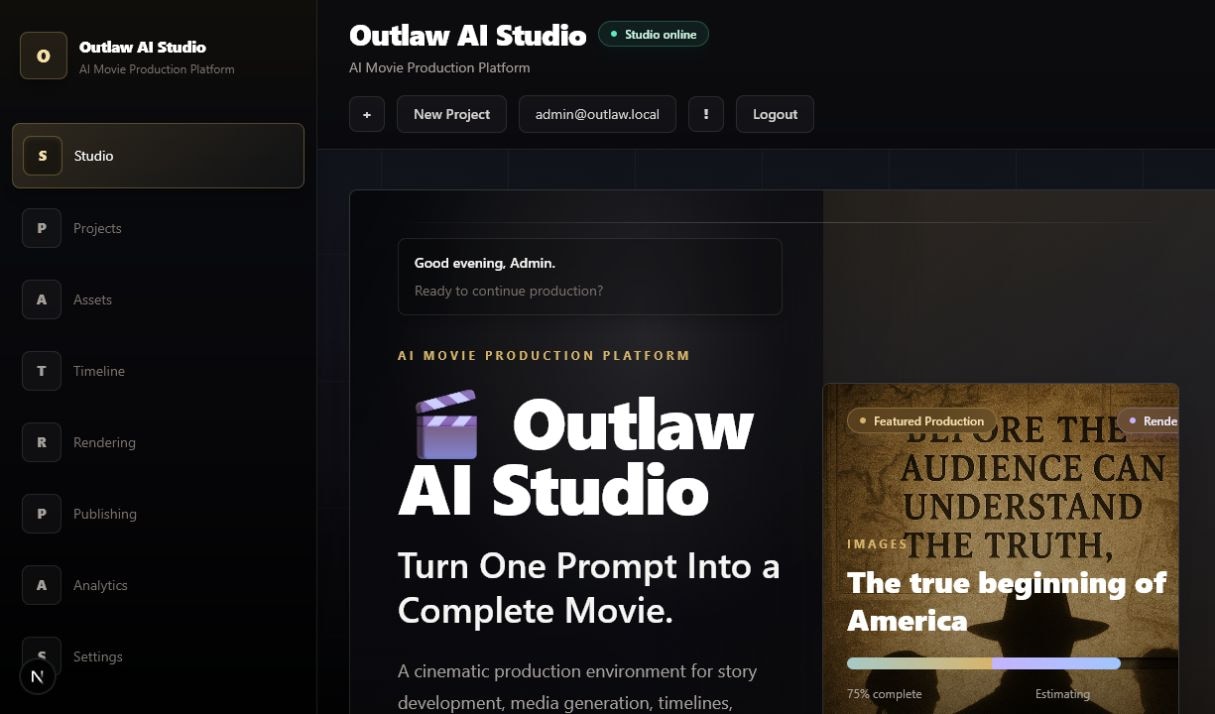
Move AI video creation from a collection of disconnected generators into a directed production environment. Every asset carries context, every scene participates in continuity, every render crosses an explicit contract, and every completed movie remains reviewable, manageable, and ready for publishing preparation.
Technology only matters when it improves how the business operates.
The platform coordinates the full generation and assembly pipeline rather than returning an isolated clip.
Story Bible, Character Lock, World Lock, scene intelligence, and asset intelligence preserve context across stages.
Camera direction, effects, color, transitions, pacing, audio, subtitles, and mastering are applied through the cinematic and composition engines.
Every step hands structured state to the next, keeping the experience understandable and the system observable.
A grounded view of what each product is designed to operate, based on its current repository and documented roadmap.
A staged worker pipeline generates and records every production layer.
Persistent production memory reduces drift across long-form work.
Specialized engines coordinate narrative, media selection, and creative direction.
A versioned renderer contract isolates upstream production from FFmpeg composition internals.
A deterministic director/editor plan turns assembled assets into an authored movie language.
Completed operational systems cover the work around production as well as generation itself.
Dense systems should still feel understandable. Purpose-built workspaces keep critical state visible without turning the interface into noise.
Security, scalability, integration boundaries, performance, and administration are part of the product—not an appendix.
The monorepo separates the Next.js Studio, NestJS API, BullMQ workers, shared contracts, PostgreSQL/Prisma data, and Redis queues.
Processors decide what to generate while provider classes decide how, with startup validation, fallback behavior, metadata, storage, and dashboard viewers.
Renderers consume a versioned contract rather than projects, database entities, provider implementations, or timeline internals.
Authentication protects projects and assets while the commercial control plane separates encrypted provider secrets from production metadata.
Representative ways teams can apply the platform without reducing it to a generic feature list.
Turn a subject into researched chapters, narrated scenes, consistent visuals, a directed timeline, and a mastered video asset.
Share projects, comment, request reviews, approve assets, inspect activity, and preserve continuity across contributors.
Use templates, cloud render queues, storage governance, analytics, and publishing preparation to operate multiple productions systematically.
Available capability, active validation, and roadmap direction are presented separately.
Core AI, rendering, cinematic, continuity, storage, collaboration, cloud rendering, analytics, commercial operations, and public website systems are documented as complete.
Current work covers complete production-render validation, provider credential onboarding, continuity hardening, storage governance, and operational readiness.
Publishing preparation and provider-state architecture exist; real external uploads, OAuth, and credential-specific integrations remain provider work.
This page is already designed to hand off naturally when the standalone AI Movie Studio website is ready.
The documented product focuses on faceless historical documentary videos produced from one prompt through a structured, multi-stage pipeline.
Yes. The repository documents a complete rendering and cinematic pipeline, FFmpeg composition, audio mixing, subtitle burn-in, export profiles, and archived successful render milestones.
Character profiles, World profiles, approved references, Character Lock, World Lock, Story Bible memory, and continuity-aware downstream stages carry identity and setting context through the production.
The Publishing Center prepares metadata, schedules, export assets, and provider states. Real external uploads and OAuth are explicitly documented as deferred provider work.
The current documentation lists OpenAI for images, ElevenLabs for voice and music, with mock providers still used for sound effects and subtitles.
We engineer commercial software, infrastructure, and digital systems that do not fit inside pre-built boxes.
Start a conversation